
Class 2B vs 2A motorcycle, Class 2A Motorcycles, Class 2B Motorcycles, Motorcycle Class
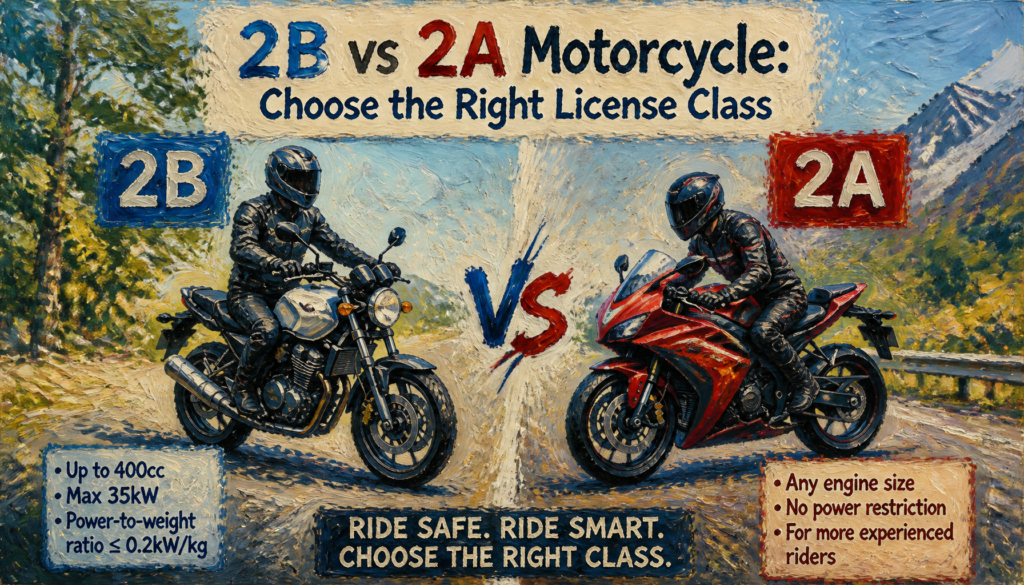
2B vs 2A Motorcycle: Choose the Right License Class
Aug
2B vs 2A Motorcycle: Many riders face a real blocker when planning their next step: choosing between 2B and 2A feels risky and confusing. If you are deciding between 2B vs 2A Motorcycle, one label can change what your licence lets you do and how quickly you can move forward. That small choice affects your training path, the test you sit, and the kind of motorcycles you can legally ride.
This guide is for riders and learners in 2026 who want a clear answer before they waste time. We will quickly explain the purpose of class 2B and class 2A, how they differ, and what a typical upgrade route looks like. You will also learn how to test your current skill level against each class, what to check before applying, and where people often lose time by picking the wrong class too early. You do not need a law degree to sort this out. By the end, you will know which class is the right fit for your goals right now. Next, we will break down each class, step by step, so you can choose with confidence.
2B vs 2A Motorcycle Licence Classes in 2026: Choose the Right Licence Before You Ride
2B vs 2A Motorcycle: Before you book a test, buy a bike, or start your upgrade plan, decide how you will actually ride. If you are a beginner, commuter, or rider stepping up from a smaller class, the decision usually comes down to confidence, budget, and legal room to grow—not just headline power. This section is about real-world outcomes for the 2B vs 2A motorcycle licence choice in 2026, so your first purchase matches both your skill level and your plans.
In simple terms, 2B is generally positioned for riders entering the motorcycle world on smaller-displacement, lower-power machines, while 2A opens the door to a broader group of higher-capacity motorcycles. If your area’s regulator has staged testing, medical checks, age rules, or mandatory training modules, those thresholds define the practical path more than your dealer’s advice. That is why many riders regret waiting too long to verify 2B licence limits before paying for a bike they cannot legally use.
| Factor | 2B class focus | 2A class focus |
|---|---|---|
| Legal scope | Built for manageable entry-level riding and lower-risk machines. | Designed for broader machine access and stronger legal flexibility than restricted classes. |
| Engine and performance fit | Typically lighter, easier-to-control engines and smoother power delivery. | Higher-capacity performance envelope, often stronger acceleration and sustained cruising ability. |
| Rider profile | Best for learners and riders still building throttle, braking, and body-position habits. | For experienced riders seeking more speed, power reserve, and varied riding conditions. |
| Skill emphasis | Focus on smooth control, gear transitions, and urban traffic management. | Demands more confidence with weight, stronger braking, and higher-speed judgment. |
| Cost and running habits | Often lower running cost profile, useful for commuting and practice miles. | Can mean higher insurance, fuel, and maintenance exposure depending on bike choice. |
2B vs 2A Motorcycle: When comparing classes, consider where your daily reality sits. If you store bikes in tight urban housing, ride short trips, and value lower insurance stress, 2B is usually the sensible start. If you commute long distances, tour regularly, or want less upgrade friction later, many riders eventually move toward a higher-capability class to avoid hitting a legal ceiling too soon.
- Can you pass a practical test comfortably in city traffic?
- Will your current bike choice remain legal once purchased?
- Do local licence rules allow a short staged upgrade path?
- Is your budget built for long-term ownership, not only the showroom price?
For many people, the strongest move is to begin with a compliant option, gain miles, then progress after experience and income are aligned with usage goals. If you are focused on reliability, lower friction, and confidence, prioritize passing 2A licence requirements only when your training, confidence, and route pattern justify the jump. That approach protects your time, keeps you compliant, and usually saves money while you build a riding identity you can grow with.
2B vs 2A Motorcycle Licence Basics: What Each Class Actually Allows
2B vs 2A Motorcycle: When comparing the 2B vs 2A Motorcycle classes, the most important first step is to match your riding goals with the exact legal definition in your own jurisdiction. Many riders get confused because naming systems change by country or state, and a category code can carry slightly different conditions for training, testing, and endorsement dates even when it sounds similar. So, always treat this as a rights-and-restrictions comparison, then verify every detail with your local transport/licensing authority.
2B is generally the entry-level path for riders moving beyond learner-level status into lower-capacity motorcycle use, while 2A covers a broader permission to ride more capable motorcycles and often comes after stricter progression requirements. In practical terms, most riders find 2B easier to obtain first because the legal burden is usually lighter in terms of machine complexity and risk exposure, while 2A supports broader road use once experience and credentials are stronger.
Core legal comparison
| Criteria | Category 2B | Category 2A | Relation to learner / special-use stages |
|---|---|---|---|
| General legal scope | Restricted to lower-capacity / lower-performance motorcycles as defined by law. | Permission extends to larger-capacity and higher-performance motorcycles under the rules for this class. | Usually sits above provisional or learner phases, but the exact mapping depends on local licensing policy. |
| Typical eligibility | Minimum age, approved training, and fitness requirements are set by the local authority. | Higher entry standards are often required, with progression conditions linked to experience or previous category records. | Some authorities require completion of prior riding stages before 2A can be added. |
| Tests and checks | Theory plus practical competence assessment is common; medical check requirements vary. | May include additional practical competency expectations and stricter medical review standards. | Medical declarations and endorsements can differ for both classes and must match current health regulations. |
| Buying and use fit | Often suitable for city commuting, tighter traffic, easier storage, and lower first-bike anxiety. | Better for long-distance rides or higher-performance intent once confidence and budget support it. | Licensing progression usually mirrors how quickly riders want to scale handling, maintenance, and insurance complexity. |
2B vs 2A Motorcycle: For riders with limited storage space, daily commute distances, or tight budgets, starting with 2B often reduces friction: lower running complexity and usually easier-to-manage insurance and training costs. If you live in a city with heavy congestion or rely on secure indoor parking, smaller bikes allowed under 2B can be a practical advantage.
Decision hint
- If you are new, want legal certainty quickly, and prioritise control and affordability, begin with 2B and confirm upgrade rules early.
- If your goal is frequent touring or advanced performance riding, plan your timeline so your upgrade path to 2A aligns with completed training and medical requirements in your state.
- Before applying, compare licensing office timelines and fees, because local incentives for safety courses or testing windows can materially affect when you can ride legally.
In short: in this 2B vs 2A Motorcycle choice, confidence and compliance usually win over horsepower. Clear understanding of your local rules now will save money, avoid delays, and make the right class upgrade decision at the right time.
Quick Specs: 2B vs 2A Motorcycle Licence Limits at a Glance
2B vs 2A Motorcycle: When comparing licence categories, the fastest way to reduce confusion is to map what is actually required by law before you register, train, or buy. This 2B vs 2A Motorcycle quick-spec view focuses on the official points that drive cost, timeline, and legal riding limits, so you can choose the class that matches your current skill level and your real-world route—not marketing claims from sellers.
These values are jurisdiction-dependent. The section data below is a compliance-oriented template you can match against your transport authority’s published rules: minimum age, training modules, exam structure, waiting period, validity period, upgrade path, and statutory power/engine limits are all set by local regulation and can shift between regions. Confirm each field on the authority site before booking lessons, paying for endorsements, or ordering protective gear and bikes.
| Licence class | Minimum age | Required training modules | Test type / duration | Waiting periods | Licence validity | Class upgrade path | Statutory power/engine limits | Ideal rider profile |
|---|---|---|---|---|---|---|---|---|
| 2B | Defined by your local licensing authority | Authority-prescribed beginner-focused modules and knowledge components | Authority-defined practical and theory assessment format; duration varies by region | Regional rules apply; confirm staged timing with official scheduler | Set by statute (renewal cycles vary by authority) | Step-in pathway to broader categories after meeting legal training and test requirements | Class cap is legally specified by the authority and can include limits on power/engine class | Best fit for new riders, city commuters, and people who want legal confidence before moving to higher-powered bikes |
| 2A | Defined by your local licensing authority | Authority-prescribed advanced modules for higher-capacity motorcycle operation | Authority-defined practical and theory assessment; often more demanding than 2B, duration set locally | Regional rules apply; typically tied to completion milestones or prior class dates | Set by statute (renewal cycles vary by authority) | Advanced class from this point or upgrade route based on official criteria and records | Authority-defined statutory power/engine ceiling for 2A; typically above the lower class cap | Suitability is strongest for experienced riders, touring/long-distance use, and riders seeking broader performance and bike choice |
2B vs 2A Motorcycle: From a purchase perspective, the table is where most delays start: people often buy a machine too soon, then discover it exceeds the power rule for their current class or does not fit their staged licence pathway. Pair this quick-check with a dealer who can confirm class-legal inventory, and your upgrade risk drops significantly.
- Use this as a pre-buy checklist: age, training, and exam timing should be your first filters, not displacement alone.
- Plan around your city’s testing calendar and local waiting periods; this can be a stronger constraint than price.
- If your goals are future-ready, start with the safest legal class you qualify for today, then upgrade with confidence once records and readiness are in place.
For anyone deciding now, the right class is the one your body, skill, and local regulation allow today. Get the official page screenshot or printout before paying deposits, then move to a trial with your preferred instructor or training center.
2B vs 2A Riding Characteristics: Engine Capacity, Power, and Handling Differences
2B vs 2A Motorcycle: When you’re deciding on the 2B vs 2A Motorcycle progression, riding characteristics matter as much as legal eligibility. In practice, this comparison comes down to how each class handles real traffic demands: stop-and-go city loops, fast highway merges, and technical mountain sections where throttle and body position matter quickly. Because classes are tied to licensing structure, the feel on the road often reflects the intent of each category—2B as an entry-friendly step, 2A as a broader-performance tier.
2B-style machines are usually lighter and less intimidating for new riders, which makes mistake recovery easier in traffic and gives beginners more room to refine braking points and throttle finesse. 2A bikes are commonly chosen for stronger performance potential, so they can carry better pace once you know how to ride a smoother entry throttle and smoother line changes. If you’re deciding which feels safer for daily use, this difference is often the deciding factor before purchase price or brand ever comes up.
| Riding scenario | Typical 2B behavior | Typical 2A behavior | Which feels safer / more capable? |
|---|---|---|---|
| City traffic | Quicker to manage at low speed; easier steering corrections and less intimidation in tight lanes. | More power can be present at fingertip, so precision on the clutch and throttle matters more. | For new riders and high-density commuting, 2B usually feels more manageable. |
| Highway merge | Predictable roll-on acceleration, but lower momentum reserve; lane changes may require earlier planning. | Stronger acceleration and higher-end thrust reduce hesitation in busy merges and overtakes. | For confident riders on longer commutes, 2A can reduce stress once skills are solid. |
| Mountain roads | Can feel nimble in tight hairpins, especially for lighter loads and lower cruising speeds. | More engine reserve helps carry speed through elevation changes and longer exits. | For technical comfort, 2B is often easier; for pace and overtaking opportunities, 2A is more capable. |
| Braking and crash sensitivity | Generally more forgiving braking modulation and easier recovery if momentum drops unexpectedly. | Harder stop demands greater braking confidence; abrupt throttle changes can amplify risk. | Safer error window tends to be wider on 2B, especially while learning. |
2B vs 2A Motorcycle: If your routine includes short urban rides, limited storage, and cautious budget planning, choosing 2B first is often practical. Many riders skip costly upgrades by staying in the right-sized class until confidence and routes demand more. That reduces early frustration and makes each training hour count.
If your goals include consistent touring, frequent highway travel, or high-throttle riding, moving into 2A can be worth the additional skill investment. Before buying, confirm local licensing eligibility rules, any progression requirements, and insurance expectations with your dealer or licensing office, then compare a test ride and not just brochures. That simple step gives you objective proof of comfort, which is usually the best confidence-to-cost decision in this category split.
Rider Skill and Confidence: Why 2B Is Often the Starter Choice and When 2A Demands More
2B vs 2A Motorcycle: In a 2B vs 2A Motorcycle comparison, riders often focus on engine size before they understand the behavioural shift required on the machine. For most beginners, 2B is the better starting class because it lets you build habits in real traffic without the same level of stress amplification. You learn to judge flow, spacing, and lane position while still having margin for small errors. If you live with daily commuting, urban congestion, or shorter practical training windows, this staged approach usually gives better long-term consistency than jumping straight into a high-demand class too early.
Traffic management is the first gate. On 2B, you should be calm in stop-start conditions, comfortable making lane changes with clear indicators, and able to choose safe lines around intersections without rushing. From there, your throttle modulation and smoothness become your safety tools, because jerky inputs are a bigger issue than outright power in this phase. You also start to read the environment: when a rider ahead hesitates, when a truck blocks visibility, and when to create extra room early.
2A demands stronger foundations because it increases the impact of rider inputs in every phase of riding. Faster pace cornering means you must control entry speed with much more precision, and emergency braking has less forgiveness when momentum is higher. Cornering confidence, body position, and panic-recovery choices become critical, since a late correction or abrupt rear-wheel input can be destabilising. This is why many experienced instructors recommend spending meaningful time in 2B before moving on, even if you feel ready emotionally.
2B vs 2A Motorcycle: If you want a grounded upgrade path, use practical readiness checks rather than opinion alone. These are useful regardless of your location, and they align with how schools and licensing stages are commonly structured:
- Riding hours and consistency: Enough time logged in varied road conditions, not just one quiet weekend route.
- Crash-avoidance comfort: You can repeatedly spot hazards early and choose preventive control instead of emergency reactions.
- Traffic confidence: You can hold position in moderate congestion without rushing decisions.
- Throttle and braking control: Smooth roll-ons and progressive squeeze braking are predictable and repeatable.
- Cornering discipline: You can maintain line and rhythm through mixed-speed bends while watching exits.
- Fatigue management: After a longer ride, you remain clear-minded and can still recover from minor mistakes.
- Instructor recommendation: A professional mentor should sign off that your technique is solid enough for the next step.
When those boxes are genuinely crossed, the move to 2A becomes a confidence-based progression, not a status move. If you are still unsure, staying with 2B builds stronger fundamentals and lowers risk while you continue riding practically and affordably. That usually leads to a cleaner upgrade later—fewer setbacks, better decision-making, and a much smoother transition once your skills truly match the demands.
Cost, Maintenance, and Daily Use: 2B vs 2A Ownership Reality Check
2B vs 2A Motorcycle: When comparing the practical side of 2B vs 2A Motorcycle ownership, most buyers focus first on purchase price and then discover hidden costs. Licence class affects not just what you can ride, but how much you pay to keep it. If your riding profile is early-stage, urban, and budget-conscious, 2B often feels easier to live with because most 2B-eligible machines sit in a narrower cost bracket and are simpler to run daily.
Insurance pricing is usually influenced by class, machine size, and risk profile, so the first-year premium gap can be noticeable. Add to that local regulatory differences in registration and coverage assessment, and the total monthly burn rate for 2A ownership can be meaningfully higher for some riders. In places where storage is limited—street parking, secure compounds, or shared housing—fitting, moving, and managing a larger, more powerful bike can also create practical friction that silently increases total ownership.
Use this reality check to compare short-term and mid-term costs:
| Ownership Factor | 2B (1-Year / 3-Year) | 2A (1-Year / 3-Year) | Best Fit |
|---|---|---|---|
| Upfront purchase & resale flexibility | Usually lower entry cost and easier resale when needs change. | Higher starting cost, bigger model choice, and bigger depreciation swings in early ownership. | 2B for cautious spenders, 2A for budget-ready enthusiasts. |
| Insurance & licensing risk factors | Often lower early premiums due to lower-risk profile assumptions. | Typically higher premium pressure, especially in the first years of use. | 2B for first-time owners, side workers, and city commuters. |
| Fuel and running efficiency | Generally leaner fuel use on stop-start riding and shorter trips. | Higher displacement and performance often mean more frequent refuels on mixed routes. | 2A for riders who value strong highway performance. |
| Maintenance rhythm and costs | Routine servicing tends to stay simpler and more predictable. | Service tasks and consumables often cost more over time on larger, heavier setups. | 2B for tighter maintenance budgets. |
| Tyres, pads, and usage stress | Usually slower wear in moderate commuting patterns. | Higher speed and mass can increase tyre and brake wear if ridden hard. | 2A when mileage goals and style justify replacement costs. |
2B vs 2A Motorcycle: For one-year decisions, 2B tends to be the practical default for daily commuting because hidden costs stay flatter and confidence gaps are easier to manage. If your year also includes lots of short trips and tight parking, that flexibility is worth more than raw power.
Over three years, the story can flip for people who do consistent touring or long-distance riding, where time and distance can justify moving into 2A. The right move is to match category choice with your real commute distance, storage situation, and confidence level rather than headline specs. A staged plan—start practical, then upgrade when use-case and savings justify it—usually removes buyer’s remorse and keeps the ride financially calm.
- Choose 2B first if you want predictable cash flow and simpler daily logistics.
- Move to 2A once distance riding becomes your primary use and cost tolerance has matured.
2B vs 2A vs Other Motorcycle Categories: Comparing the Closest Alternatives
2B vs 2A Motorcycle: When evaluating 2B vs 2A Motorcycle pathways, many buyers underestimate how much nearby categories influence both cost and confidence. The category right below this level often serves as the most practical first step: you learn real-road habits, train in manageable conditions, and reduce early spending before entering higher-capability machines. If your local licensing system uses staged progression, this lowers upgrade friction and helps avoid paying for a class you do not yet need.
In the middle sits 2B, often described as the balanced choice, while 2A sits nearer the top of the standard rider ladder. Even without focusing on specific numbers, the practical difference is clear: smaller, lighter bikes are easier to control in congested riding, and larger machines demand more confident braking, throttle, and body control. That is why beginners commonly start with 2B and consider moving up only once lifestyle and skill justify it.
| Category | Ability & performance scope | Age / test expectations | Cost & upgrade friction |
|---|---|---|---|
| Lower motorcycle category | Entry-level performance, easier handling for first-time controlled road use. | Generally simpler entry requirements and shorter, simpler test focus. | Lowest ownership cost footprint; natural first step toward 2B. |
| 2B | Mid-range machines suited to daily commuting and mixed city/suburban riding. | Higher eligibility bar than entry tier, but lower complexity than top-level power classes. | Middle pricing on buy-in, insurance, fuel, and service; commonly the smoothest upgrade pivot. |
| 2A | Broader performance range for stronger acceleration and sustained road speed. | Typically higher demonstration threshold and deeper practical competency checks. | Usually higher running and insurance profile; upgrade is more comfortable after proven 2B experience. |
| Higher category (above 2A) | Advanced-performance class with the largest operating envelope. | Usually the strictest competency requirements in staged systems. | Highest ownership cost and the most difficult transition from basic classes. |
2B vs 2A Motorcycle: Use this grid to choose the most practical entry level for your situation. In dense cities, younger riders, and apartment-based storage setups, the lower-cost, lower-friction path often wins. In those environments, a smaller category or 2B can deliver better convenience and lower ongoing cost than moving straight into 2A.
- Pick lower category first if your immediate need is basic city mobility and you want less test stress.
- Pick 2B if you need a realistic upgrade from beginner skills with good value for commute and weekend use.
- Pick 2A when your budget and routes support faster, longer, and more demanding rides.
- Delay upgrade if fuel and service costs are a bigger pressure point than speed.
- Reconsider after each season of ridden kilometres and local road use, then upgrade only when regulation, budget, and skill all align.
For most riders, the best decision is not “how powerful can I get now,” but “which class protects my wallet, builds confidence, and keeps me legal.” A staged approach makes upgrades less risky, more affordable, and much easier to justify when you eventually want the performance of 2A.
2B vs 2A and Your Local Constraints: Registration Rules, Upgrading Deadlines, and Regional Subsidies
2B vs 2A Motorcycle: When you’re deciding between the 2B vs 2A Motorcycle path, the first obstacle is not engine numbers but your local licensing office. Regional rules can change how officials define legal use, so a bike that seems right on paper can become a problem at renewal time or during enforcement stops if you skipped the details. Before buying, think like a buyer in your city: who inspects your paperwork, when deadlines apply, and what happens if you ride outside your class limits.
2B is typically the entry route because it is often paired with more manageable engine capacity and power expectations, and it is commonly recommended for newer riders. 2A usually opens up to larger-capacity, higher-performance machines with stronger acceleration and handling demands, which means stronger responsibility for throttle, braking, and body control. If your routine is commuting, parking in tight areas, or mixed traffic in dense neighborhoods, aligning class choice with practical use keeps legal risk low and insurance costs more predictable.
| What to verify at DMV/transport office | Why it matters for 2B vs 2A choice | Best question to ask |
|---|---|---|
| Local registration rules and class limits | Some regions focus more on engine capacity checks while others use power-focused enforcement | “Which models are allowed under my current class in this state/city?” |
| City riding restrictions | Noise, access, and zone limits can affect daily usability of high-performance bikes | “Are 2A-eligible bikes restricted in low-speed or urban districts?” |
| Upgrade and retest timeline | Progression wait times and validity windows differ and may delay your transition plans | “What is the exact minimum wait and testing sequence to move from 2B to 2A?” |
| Insurance and liability alignment | Riding above your licence class can increase penalties, void coverage, or create legal exposure after an accident | “How is insurance treated if a rider accidentally exceeds class limits?” |
| Training vouchers / fee waivers | Regional subsidies can reduce the total cost of upgrades and tests | “Are there any current test fee waivers or training vouchers for my licence progression?” |
Local enforcement differences also affect upgrades. If you expect to advance later, build your timeline around official deadlines instead of dealership promises. Riders often buy a lower-class bike first, gain confidence, and then upgrade once local eligibility is clear—this avoids rushed decisions and reduces the chance of buying a bike that can’t be legally enjoyed immediately.
- Ask for updated policy notes in writing, especially if you store your bike in shared housing or limited parking zones.
- Check whether test appointments have seasonal backlogs that could affect your plans.
- Confirm any available incentives early so your total ownership cost is transparent before committing.
- Choose practicality over image: a compliant 2B starter choice often creates the smoothest path to future growth into 2A.
By validating these local constraints up front, you reduce delays, avoid fines, and keep your purchase decision aligned with both performance goals and lawful use. That confidence usually saves money in the long run and helps you ride only what your license, city rules, and budget can fully support.
Frequently Asked Questions
Can I ride a 2A bike with a 2B licence?
No, you should not assume a 2B entitlement covers 2A-level motorcycles. In the 2B vs 2A decision, licensing class is the legal boundary, and riding above your entitlement can create fine and insurance complications during claims. If your goal is a bigger, higher-performance bike, upgrade your licence first and test with a compliant trainer bike in your region before purchasing.
How long should I stay on 2B before upgrading?
There is usually no universal minimum duration; practical readiness matters more than calendar time. Stay on 2B until you are fully confident with lane control, traffic merges, braking, and throttle smoothness in everyday conditions. Many riders upgrade after they can ride consistently and safely in the scenarios they will actually face, rather than chasing a class switch for prestige.
Is 2B enough for touring or highway use?
For many riders, 2B is enough for city commuting and short highway connectors. If your plan includes sustained high-speed stretches, fully loaded weekend travel, or long-distance comfort demands, a 2A category may become more practical. Think about your route profile and luggage/peer passenger load before deciding, because that use-case often matters more than daily mileage.
Which licence has lower insurance cost in India/Europe/US?
There is no single global answer for India, Europe, and the US; pricing is local and insurer-specific. In practice, cost is usually influenced by rider profile, location, bike details, and claims history, with the licence class used as a risk indicator in the quote. A good way to control spend is to compare two full quotes in your exact region and clarify planned upgrade timing; this avoids surprises when switching from 2B to 2A-level ownership.
Can I test for 2A directly or do I need experience proof?
Rules differ by country and even by local licensing authority, so the safe path is to confirm local requirements before booking your test date. In some jurisdictions you can apply directly for 2A, while others ask for prior steps or stronger proof of riding maturity. Bringing structured training records, a clean riding log, and helmet-to-license readiness can make the process smoother and saves you from retakes that delay your purchase decision.
Should You Choose 2B or 2A Motorcycle Licence? Use This Quick Decision Rule and Register Today
2B vs 2A Motorcycle: When choosing between 2B and 2A Motorcycle licence classes, the best move is not to chase power; it is to match legal access, safety, and your next 12 months of riding goals. If you are reading this to resolve the 2B vs 2A Motorcycle dilemma, start with your current reality: your skill level, where you ride, and how much you can spend on entry and ownership.
Both classes have different engine-capacity and vehicle-use scope rules, plus rider eligibility requirements that are controlled by your local licensing authority. That means two riders with the same bike budget can face very different outcomes depending on where they register. A practical choice now saves you from forced retests, delayed plans, or buying a motorcycle you are not yet legally comfortable controlling.
Quick 3-step recommendation framework:
- Step 1: Skill first. New riders should normally begin with 2B. For many beginners, this class offers a lower-risk entry point for learning balance, throttle control, and braking transitions in real traffic. If you are already confidently handling heavier traffic and can predict your reaction margins, 2A may be the faster path to full freedom.
- Step 2: Match daily and weekend use. If your bike is mainly a city tool, commuter, or short-hop machine, 2B is usually the better fit. If your routine is touring with long stretches, highway overtaking, or high-confidence weekend performance riding, 2A tends to suit the job better.
- Step 3: Fit it to budget and storage habits. In many cases, 2A ownership can feel heavier on insurance, servicing, and fuel over time, especially if the motorcycle sits longer and must handle varied use. If your budget is tighter and you need easy weekly usability, starting with 2B is often the smarter conversion path.
2B vs 2A Motorcycle: By rider type, the fast decision is clear: Beginner = 2B; commuter = 2B; weekend rider usually starts at 2B and upgrades only if needed; distance rider should choose based on comfort with longer rides and legal limits; performance-seeker should usually plan for 2A once skills catch up.
If you are ready to decide today, take three actions: verify your local class limits and eligibility conditions, book your theory and practical tests, and set a 12-month upgrade plan so your next class move is scheduled, not accidental. Register now with a clear roadmap, and you avoid the common buyer’s-regret cycle of buying for now and outgrowing it too soon.
We at Speedzone specialize in offering top-quality servicing for a variety of premium motorcycle brands. Whether you ride a Yamaha, Honda, KTM, Suzuki, Kawasaki, SYM, Aprilia, Piaggio, or Mutt Motorcycle, you can trust us to keep your ride running smoothly.
Book Your Service Today
Ready to give your motorcycle the care it deserves? Or just curious to know more? With our premium motorcycle accessories available catering to every motorbike models. Book your motorcycle servicing with us or drop by our showroom today and experience the difference of expert servicing tailored to your brand and friendly staffs!
